
☕ Catching up — Phrasal Verbs in Context
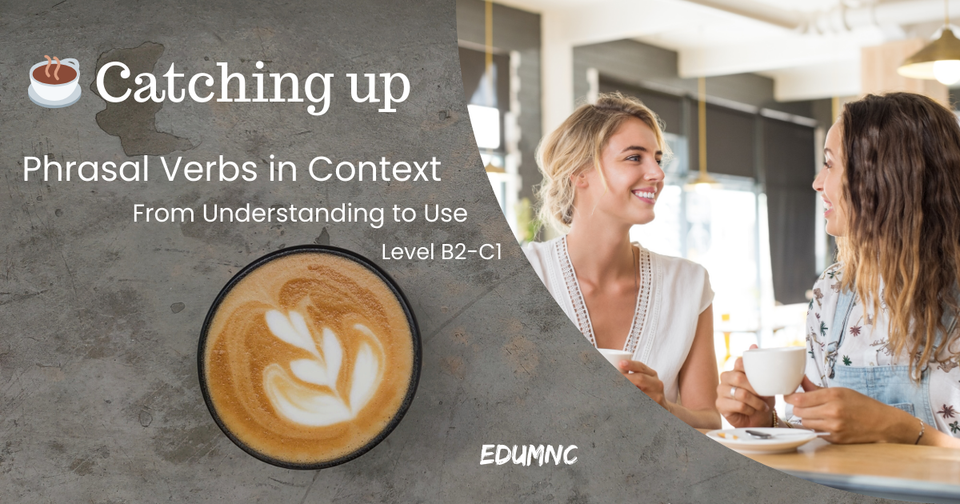
Level B2–C1 | Full lesson Language focus: phrasal verbs · Skills: listening, reading, vocabulary in context · Format: dialogue-based
Phrasal verbs nu se învață din liste. Se învață din conversații. Problema e că majoritatea cursurilor îți dau 50 de phrasal verbs într-o lecție, fără context, fără logică, fără nimic care să te ajute să le ții minte.
Lecția asta face invers. Pornești de la o conversație reală între doi prieteni. Unul dintre ei și-a schimbat complet viața. Iar phrasal verbs apar natural — exact cum apar în engleză: peste tot, tot timpul, fără avertisment.
🎧 Listen first
Step 1 — First listening. Listen to the full conversation without reading the text below. Don't pause, don't go back. Just listen and try to understand the general situation.
Step 2 — Second listening. Listen again, this time following the written dialogue below. Pause after each line if you need to.
I. THE DIALOGUE
Emma and Sophie haven't seen each other in months. They run into each other at a café.
Emma: Sophie! I can't believe it! I haven't seen you in ages. What have you been up to?
Sophie: Emma! Yeah, it's been a while. Honestly? A lot has changed. I ended up quitting my job back in March.
Emma: Wait, seriously? I thought you were doing well there. What happened?
Sophie: I was, sort of. But I'd been putting off the decision for months. I just wasn't happy, you know? I kept telling myself things would get better, but they didn't. So one day I just handed in my notice.
Emma: Wow. That takes guts. Did you have anything else lined up?
Sophie: Not really. I'd been looking into a few things — freelancing, maybe going back to uni — but nothing concrete. I figured I'd take some time off and figure it out.
Emma: And? Did you figure it out?
Sophie: Kind of. I came across this online course on UX design, completely by chance. I signed up, got really into it, and one thing led to another. I ended up getting a freelance gig through someone on the course.
Emma: That's amazing. So you're doing UX now?
Sophie: Yeah, I've been doing it for about three months. It's not easy — I'm still picking it up as I go — but I genuinely look forward to working every morning. That never happened at my old job.
Emma: I'm really happy for you. I've been thinking about making a change myself, actually. But I keep putting it off.
Sophie: I get it. It's scary. But honestly, the hardest part is just going through with it. Once you've taken the leap, everything else falls into place.
Emma: Maybe I should look into it more seriously. Can I pick your brain sometime?
Sophie: Anytime. Let's not leave it so long next time, yeah?
Emma: Deal.
II. GLOBAL COMPREHENSION
Answer without looking at the dialogue. It's fine if you don't remember everything.
1. Where does the conversation take place?
2. How do Emma and Sophie know each other?
3. What big change has Sophie made recently?
4. Is Sophie happy with the change? How do you know?
5. How does Emma feel about her own situation?
Check your answers in section VII.
III. DETAILED COMPREHENSION
Read the dialogue again, then answer.
1. Why did Sophie leave her job?
2. Did Sophie have a job before quitting?
3. How did Sophie discover UX design?
4. According to Sophie, what is the hardest part of making a change?
5. What does Emma ask Sophie at the end?
Check your answers in section VII.
KEY EXPRESSIONS FROM THE DIALOGUE
These aren't phrasal verbs, but they deserve attention. They're common in everyday English and you'll hear them all the time.
going back to uni
I'd been looking into a few things — freelancing, maybe going back to uni...
Uni is the informal, everyday word for university — used widely in British English and Australian English. Americans tend to say college or school instead.
UX design
I came across this online course on UX design...
UX stands for User Experience. UX design is the process of designing products (websites, apps, software) so that they're easy, intuitive and pleasant to use. It's one of the most in-demand digital skills today.
You don't need to know the technical details — just recognise it as a professional field. You'll hear it in sentences like:
- She works in UX. (Lucrează în UX.)
- I'm doing a UX design course. (Fac un curs de UX design.)
getting a freelance gig
I ended up getting a freelance gig through someone on the course.
Two words to unpack here:
Freelance = working independently, not employed by one company. A freelancer takes on projects from different clients. The word works as an adjective (freelance work, freelance designer) and as a verb/noun (to freelance, a freelancer).
Gig = an informal word for a job, project or assignment — usually temporary or short-term. Originally from the music world (a musician's gig = a live performance), now widely used for any piece of paid work.
So getting a freelance gig = landing an independent, project-based job.
Other examples:
- I've got a few freelance gigs lined up this month. (Am câteva proiecte independente pregătite luna asta.)
- She does gig work on the side. (Face joburi de proiect pe lângă.)
IV. LANGUAGE FOCUS: PHRASAL VERBS
Acesta este nucleul lecției. Fiecare phrasal verb de mai jos apare în dialog. Nu le înveți izolat — le înveți din context, cu sensul pe care îl au în acea propoziție.
Ce e un phrasal verb?
Un verb + o particulă (prepoziție sau adverb) care împreună au un sens diferit de verbul singur.
- give = a da → give up = a renunța
- put = a pune → put off = a amâna
- end = a termina → end up = a ajunge (să faci ceva, de obicei neplanificat)
Asta e ceea ce le face dificile: nu le poți traduce cuvânt cu cuvânt. Dar le poți înțelege din context — și exact asta facem acum.
De ce contează phrasal verbs?
Phrasal verbs sunt extrem de frecvente în engleză — în conversație, în filme, în emailuri, în podcasts, peste tot. Un nativ le folosește constant, adesea fără să-și dea seama. Dacă le eviți, engleza ta va suna corectă, dar rigidă și nefirească.
Vestea bună: aproape fiecare phrasal verb are un sinonim dintr-un singur cuvânt — de obicei de origine latină, mai formal. Ambele sunt corecte. Dar phrasal verb-ul e cel pe care îl vei auzi în conversație.
| Phrasal verb | Single-word synonym | Register |
|---|---|---|
| put off | postpone | phrasal verb = informal / neutral · synonym = formal |
| hand in | submit | phrasal verb = informal / neutral · synonym = formal |
| figure out | understand, solve | phrasal verb = informal / neutral · synonym = neutral |
| come across | discover, encounter | phrasal verb = informal / neutral · synonym = formal |
| look into | investigate, explore | phrasal verb = informal / neutral · synonym = formal |
| pick up | learn, acquire | phrasal verb = informal / neutral · synonym = formal |
| end up | eventually do | phrasal verb = informal / neutral · no exact single-word equivalent |
| go through with | complete, follow through | phrasal verb = informal / neutral · synonym = formal |
Exemplu concret — aceeași idee, două registre:
- Conversational: I came across an interesting article. ✅ natural
- Formal: I encountered an interesting article. ✅ corect, dar nimeni nu vorbește așa la o cafea
💡 Regula de aur: în scris formal (essays, business emails, reports) poți folosi sinonimul. În conversație și în scris informal — phrasal verb-ul e mereu alegerea cea mai bună.
Phrasal verbs din dialog — unul câte unul
1. be up to (something)
What have you been up to?
Înseamnă: Ce ai (mai) făcut? Cu ce te-ai mai ocupat?
Se folosește în întrebări informale, când vrei să știi ce a mai făcut cineva în ultima perioadă. Nu are echivalent perfect în română — e un „ce faci, ce mai e cu tine?" dar referitor la o perioadă mai lungă.
Alte exemple:
- What are you up to this weekend? (Ce faci weekendul ăsta?)
- I haven't heard from you. What have you been up to? (N-am mai auzit de tine. Ce-ai mai făcut?)
2. end up + -ing
I ended up quitting my job. I ended up getting a freelance gig.
Înseamnă: a ajunge să (faci ceva) — de obicei neintenționat, ca rezultat al unor împrejurări.
Nu e ceva planificat. E ceva care „s-a întâmplat" cumva. Asta e cheia.
Alte exemple:
- We ended up staying until 2 a.m. (Am ajuns să stăm până la 2 noaptea.)
- I went out for milk and ended up buying a TV. (Am ieșit după lapte și am ajuns să-mi cumpăr un televizor.)
💡 Structură: end up + verb-ing (mereu cu -ing, niciodată cu infinitiv).
3. put off
I'd been putting off the decision for months. I keep putting it off.
Înseamnă: a amâna.
Implică de obicei ceva neplăcut, ceva ce nu vrei să faci, dar ar trebui.
Alte exemple:
- Stop putting off your homework. (Nu-ți mai amâna temele.)
- I've been putting off going to the dentist. (Am tot amânat mersul la dentist.)
4. hand in
I handed in my notice.
Înseamnă: a depune, a preda (un document, o demisie, o lucrare).
Alte exemple:
- Have you handed in your assignment? (Ți-ai predat lucrarea?)
- She handed in her resignation last Friday. (Și-a depus demisia vineri trecută.)
5. line up
Did you have anything else lined up?
Înseamnă: a avea (ceva) pregătit, aranjat, planificat dinainte.
De obicei folosit la forma de participiu: have something lined up.
Alte exemple:
- I've got a few interviews lined up for next week. (Am câteva interviuri pregătite pentru săptămâna viitoare.)
- We haven't got anything lined up yet. (N-avem nimic pregătit încă.)
6. look into
I'd been looking into a few things. Maybe I should look into it more seriously.
Înseamnă: a cerceta, a investiga, a explora (o opțiune, o posibilitate).
Nu e un studiu profund — e mai degrabă „a vedea ce e cu...".
Alte exemple:
- I'm looking into moving abroad. (Mă interesez despre a mă muta în străinătate.)
- We'll look into the issue and get back to you. (Vom analiza problema și revenim.)
7. figure out
I'd take some time off and figure it out. Did you figure it out?
Înseamnă: a-și da seama, a găsi o soluție, a înțelege (ceva care necesită gândire).
Alte exemple:
- I can't figure out how this works. (Nu-mi dau seama cum funcționează asta.)
- Don't worry, we'll figure it out. (Nu-ți face griji, o să ne descurcăm.)
8. come across
I came across this online course.
Înseamnă: a da peste (ceva/cineva), a descoperi întâmplător.
Nu cauți activ — găsești din întâmplare.
Alte exemple:
- I came across an old photo while cleaning. (Am dat peste o poză veche în timp ce făceam curat.)
- She comes across as very confident. (Pare foarte sigură pe ea.) ⚠️ Atenție: come across as = a părea, a da impresia — sens diferit!
9. get into
I signed up, got really into it...
Înseamnă: a se pasiona de, a se apuca serios de (ceva).
Alte exemple:
- I've recently got into photography. (M-am apucat recent de fotografie.)
- He got into cooking during lockdown. (S-a apucat de gătit în timpul lockdown-ului.)
10. pick up
I'm still picking it up as I go.
Înseamnă: a învăța (ceva) din mers, fără studiu formal — prin practică, prin expunere.
Alte exemple:
- I picked up some Spanish while living in Barcelona. (Am învățat ceva spaniolă cât am stat în Barcelona.)
- Kids pick up languages incredibly fast. (Copiii învață limbi incredibil de repede.)
11. look forward to
I look forward to working every morning.
Înseamnă: a se bucura anticipat de, a aștepta cu nerăbdare.
Alte exemple:
- I'm looking forward to the weekend. (Abia aștept weekendul.)
- We look forward to hearing from you. (Așteptăm cu interes răspunsul dumneavoastră.) — formulă frecventă în emailuri.
💡 Structură: look forward to + noun / verb-ing (nu infinitiv!). I look forward to seeing you (nu ~~to see you~~).
12. go through with
The hardest part is just going through with it.
Înseamnă: a duce la capăt, a face efectiv (ceva dificil, la care te-ai gândit mult).
Alte exemple:
- I wanted to complain, but I couldn't go through with it. (Am vrut să fac o reclamație, dar n-am fost în stare s-o duc la capăt.)
- Are you sure you want to go through with the surgery? (Ești sigur că vrei să faci operația?)
13. fall into place
Everything else falls into place.
Înseamnă: totul se aranjează (de la sine), totul capătă sens.
Expresie idiomatică, foarte naturală în engleză.
Alte exemple:
- Once I accepted the situation, everything fell into place. (Odată ce am acceptat situația, totul s-a aranjat.)
- Don't force it — it'll fall into place. (Nu forța — se va aranja.)
14. pick someone's brain
Can I pick your brain sometime?
Înseamnă: a cere sfatul / a profita de experiența cuiva (informal, prietenesc).
Alte exemple:
- Can I pick your brain about something? (Pot să te consult despre ceva?)
- I'd love to pick your brain on this project. (Mi-ar plăcea să-ți cer părerea despre proiectul ăsta.)
V. SEPARABLE vs INSEPARABLE — Regula care contează
Ai observat că la unele phrasal verbs poți pune obiectul între verb și particulă, iar la altele nu? Asta e distincția separabil / inseparabil.
Separabile (obiectul poate intra între verb și particulă):
| Phrasal verb | Cu substantiv | Cu pronume |
|---|---|---|
| put off | put off the meeting / put the meeting off | put it off |
| hand in | hand in the report / hand the report in | hand it in |
| figure out | figure out the answer / figure the answer out | figure it out |
| pick up | pick up a skill / pick a skill up | pick it up |
| line up | line up interviews / line interviews up | line them up |
⚠️ Cu pronume, separarea e OBLIGATORIE:
- ✅ put it off
- ❌ ~~put off it~~
Inseparabile (obiectul vine mereu după particulă):
| Phrasal verb | Corect | Greșit |
|---|---|---|
| look into | look into the matter | |
| come across | come across a book | |
| look forward to | look forward to the trip | |
| go through with | go through with it | |
| get into | get into photography |
💡 Nu există o regulă prin care să ghicești care e separabil și care nu. Dar vestea bună: cu cât le întâlnești în context, cu atât le simți natural. De aceea listele nu funcționează — iar conversațiile, da.
VI. EXERCISES
🟢 Exercise 1 — True or False?
a) Sophie was fired from her job. b) Sophie had a clear plan before quitting. c) Sophie discovered UX design by accident. d) Sophie has been doing freelance UX for about three months. e) Emma is completely satisfied with her current situation.
🟡 Exercise 2 — Fill in the phrasal verb
Complete each sentence with the correct phrasal verb from the lesson. Use the right form (tense, -ing, etc.).
a) I __________ an amazing restaurant while walking around the city. (am dat peste)
b) She's been __________ learning to drive for years. (a amâna)
c) We went to the cinema and __________ watching three films in a row. (a ajunge să)
d) I can't __________ how to use this app. (a-și da seama)
e) I'm really __________ the concert next week. (a aștepta cu nerăbdare)
f) He __________ his resignation yesterday. (a depune),
🟠 Exercise 3 — Separable or Inseparable?
Rewrite each sentence, replacing the underlined noun with a pronoun (it / them). Be careful with word order.
a) I need to figure out the problem. b) She's looking into the options. c) We keep putting off the decision. d) I came across this article online. e) He handed in his essay late.
🔴 Exercise 4 — Choose the correct option
a) I ended up __________ there for three hours. i) to stay ii) staying iii) stayed
b) I look forward to __________ from you. i) hear ii) hearing iii) to hear
c) She's really got __________ yoga recently. i) up ii) into iii) on
d) Can I pick __________ about the project? i) your brain ii) you brain iii) your brains
e) He put __________ until the last minute. i) off it ii) it off iii) it on
🟣 Exercise 5 — Use them yourself
Answer these questions about YOUR life. Use at least one phrasal verb from the lesson in each answer. Write 2–3 sentences.
a) What have you been up to recently?
b) Have you ever ended up doing something completely unplanned? What happened?
c) Is there something you've been putting off? Why?
d) Have you ever come across something that changed your life — a book, a course, a person?
e) What are you looking forward to right now?
VII. ANSWERS
Global Comprehension (section II)
1. At a café — they run into each other. 2. They're friends who haven't seen each other in a while (the dialogue doesn't specify more). 3. Sophie quit her job and started a career in UX design as a freelancer. 4. Yes — Sophie says she "genuinely looks forward to working every morning," something that never happened at her old job. 5. Emma has been thinking about making a change too, but keeps putting it off.
Detailed Comprehension (section III)
1. Sophie wasn't happy at the job and had been putting off the decision for months. Things didn't get better, so Sophie finally handed in her notice. 2. No — Sophie had been looking into a few things, but nothing concrete. 3. By chance — Sophie came across an online course on UX design. 4. Going through with it — actually doing it, not just thinking about it. 5. Emma asks if she can pick Sophie's brain sometime (get advice).
Exercise 1 — True or False
a) False — Sophie quit voluntarily ("I handed in my notice"). b) False — Sophie had been looking into a few things, but "nothing concrete." c) True — "completely by chance." d) True — "about three months." e) False — Emma has been thinking about making a change, which means she's NOT completely satisfied.
Exercise 2 — Fill in the phrasal verb
a) came across b) putting off c) ended up d) figure out e) looking forward to f) handed in
Exercise 3 — Separable or Inseparable
a) I need to figure it out. (separabil — pronumele intră între verb și particulă) b) She's looking into them. (inseparabil — pronumele rămâne după particulă) c) We keep putting it off. (separabil) d) I came across it online. (inseparabil) e) He handed it in late. (separabil)
Exercise 4 — Choose the correct option
a) ii) staying — end up + verb-ing, mereu. b) ii) hearing — look forward to + verb-ing, mereu. (to e prepoziție aici, nu parte a infinitivului.) c) ii) into — get into = a se pasiona de. d) i) your brain — expresie fixă: pick someone's brain. e) ii) it off — separabil + pronume = pronumele între verb și particulă.
✏️ Self-assessment — Where are you?
Bifează ce ai reușit:
- [ ] Am înțeles conversația din prima ascultare (situația generală)
- [ ] Pot explica sensul a cel puțin 10 phrasal verbs din lecție
- [ ] Știu diferența între end up + -ing și look forward to + -ing
- [ ] Pot identifica dacă un phrasal verb e separabil sau inseparabil
- [ ] Știu unde pun pronumele la phrasal verbs separabile
- [ ] Am rezolvat corect cel puțin 80% din exerciții
- [ ] Am scris propriile răspunsuri la exercițiul 5
6–7 checked? Excellent. You're ready for the next lesson. 4–5? Go back to section IV, re-read the phrasal verbs you missed, then redo the exercises. Under 4? No worries. Read everything again, slowly. Then redo. Repetition is the most underrated form of intelligence.
This lesson is part of the English B2–C1 course on edumnc.ro. If you've made it this far and actually did every exercise — well done. You didn't read an article. You did a lesson. There's a huge difference.
Subscribe for the next one. Free or premium — you choose the pace.
Vrei să primești următoarele lecții pe email? 👉 Înscrie-te aici

Comments ()