
Stative verbs - Part I
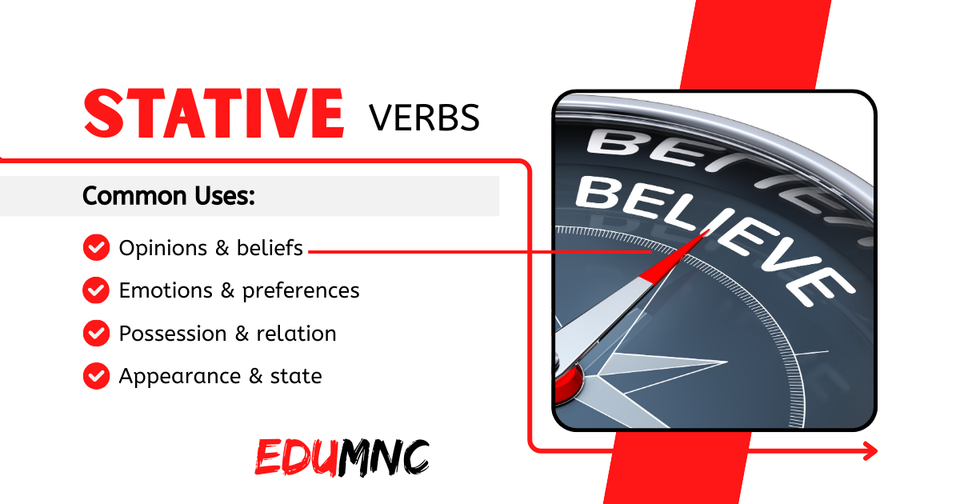
Stative verbs — De ce nu spunem „I'm knowing" sau „I'm wanting"
Level A2–B1 | Grammar lesson Focus: verbe statice (stative verbs) · Video + explicații + exerciții
Există verbe în engleză pe care nu le poți folosi cu -ing. Niciodată. Și totuși, aproape toți cursanții o fac — pentru că „sună bine". Nu, NU sună bine. Sună greșit.
I'm knowing the answer. ❌ I know the answer. ✅
She's wanting a new job. ❌ She wants a new job. ✅
Lecția asta îți arată care sunt aceste verbe, de ce nu acceptă forma continuă și cum să le folosești corect.
🎬 Watch the video
Înainte de a citi explicațiile de mai jos, urmărește acest video scurt. Ascultă cu atenție categoriile și exemplele.
I. CE SUNT VERBELE STATICE (STATIVE VERBS)?
În engleză, verbele se împart în două mari categorii:
Dynamic verbs (verbe de acțiune) — descriu o acțiune pe care o faci: run, eat, write, build, talk, etc.
Stative verbs (verbe statice) — descriu o stare: ce gândești, ce simți, ce deții, ce crezi. Nu e o acțiune — e o condiție. know, believe, own, want, need, etc.
Regula fundamentală:
Verbele statice se folosesc doar la timpurile simple (Present Simple, Past Simple etc.). Nu se folosesc la timpurile continue / progresive (-ing).
De ce? Pentru că forma continuă (-ing) indică o acțiune în desfășurare, ceva ce se întâmplă acum, temporar. Dar o stare nu se „desfășoară" — pur și simplu există.
- I know the answer. ✅ (Știu răspunsul — e o stare.)
- I am knowing the answer. ❌ (Cunoașterea nu e o acțiune în curs.)
II. CATEGORIILE — Care verbe sunt MEREU statice?
⚠️ Notă importantă: Această lecție acoperă exclusiv verbele care sunt întotdeauna statice — cele care nu acceptă forma continuă în niciun context. Nu includem verbele cu sens dublu (cum ar fi think, see, have, taste, smell, feel, etc.) care pot fi și statice, și dinamice, în funcție de sens. Acelea merită o lecție separată.
1. Opinions & beliefs — Ce crezi, ce știi
| Verb | Meaning | Example |
|---|---|---|
| believe | a crede | I believe he's right. |
| know | a ști | She knows the truth. |
| understand | a înțelege | I understand the problem. |
| doubt | a se îndoi | I doubt that's true. |
| recognise | a recunoaște | I recognise this place. |
| mean | a însemna | What does this mean? |
| suppose | a presupune | I suppose you're right. |
| agree | a fi de acord | I agree with you. |
| disagree | a nu fi de acord | I disagree completely. |
| realise | a-și da seama | I realise it's too late. |
❌ I'm believing · She's knowing · I'm understanding · I'm doubting
2. Emotions & preferences — Ce vrei, ce-ți place
| Verb | Meaning | Example |
|---|---|---|
| want | a vrea | I want a coffee. |
| need | a avea nevoie | She needs help. |
| like | a-i plăcea | I like this song. |
| dislike | a nu-i plăcea | He dislikes spicy food. |
| love | a iubi | She loves travelling. |
| hate | a urî | I hate waiting. |
| prefer | a prefera | I prefer tea to coffee. |
| wish | a-și dori | I wish I could stay. |
❌ I'm wanting· She's needing· I'm preferring· He's hating.
3. Possession & relation — Ce ai, cui aparține
| Verb | Meaning | Example |
|---|---|---|
| own | a deține | He owns a flat in London. |
| belong | a aparține | This belongs to me. |
| possess | a poseda | She possesses great talent. |
| contain | a conține | This box contains old photos. |
| consist | a consta | The team consists of five people. |
| depend | a depinde | It depends on the weather. |
| deserve | a merita | You deserve a break. |
| owe | a datora | I owe you an apology. |
| lack | a-i lipsi | He lacks experience. |
❌ He's owning · This is belonging · It's depending · She's possessing.
4. Appearance & state — Cum este, cum pare ceva
| Verb | Meaning | Example |
|---|---|---|
| seem | a părea | It seems unlikely. |
| look | a părea (sinonim: seem) | She looks tired. |
| exist | a exista | The problem still exists. |
| matter | a conta | It doesn't matter. |
| resemble | a semăna cu | She resembles her mother. |
| fit | a se potrivi | This shirt fits perfectly. |
| suit | a-i sta bine | That colour suits you. |
💡 Look ca verb static = a părea, sinonim cu seem. Nu confunda cu look = a se uita (acțiune), care acceptă forma continuă: She's looking out the window ✅. Dar: She's looking tired ❌ → She looks tired ✅.
❌ It's seeming · It's mattering · She's resembling · It's fitting.
III. COMMON MISTAKES — Ce spun cursanții vs. ce e corect
| ❌ Wrong | ✅ Correct | Why |
|---|---|---|
| I'm not understanding this. | I don't understand this. | understand = verb static |
| She's wanting to leave. | She wants to leave. | want = verb static |
| I'm believing you. | I believe you. | believe = verb static |
| I'm not agreeing with this. | I don't agree with this. | agree = verb static |
| He's owning three cars. | He owns three cars. | own = verb static |
| It's not mattering. | It doesn't matter. | matter = verb static |
| She's looking happy today. | She looks happy today. | look (= seem) = verb static |
💡 Observă: la negativ, greșeala e și mai frecventă. Cursanții spun I'm not understanding în loc de I don't understand. Forma continuă „sună" mai naturală pentru vorbitorii de română — dar în engleză e greșită cu verbele statice.
IV. EXERCISES
🟢 Exercise 1 — Quick Test: Corect sau greșit?
Marchează ✅ sau ❌. Dacă e greșit, corectează.
1. I'm knowing the answer.
2. She needs a new laptop.
3. They're not agreeing with the plan.
4. This belongs to my sister.
5. I'm really wanting that job.
6. He doesn't deserve this.
7. The box is containing old letters.
8. I don't believe a word he says.
9. This is seeming like a bad idea.
10. I wish I could help.
🟡 Exercise 2 — Choose the correct form
a) I __________ (know / am knowing) where she lives.
b) We __________ (don't agree / aren't agreeing) with this decision.
c) She __________ (owns / is owning) a beautiful house.
d) I __________ (prefer / am preferring) the blue one.
e) He __________ (doesn't deserve / isn't deserving) to win.
f) The team __________ (consists / is consisting) of 12 players.
g) I __________ (wish / am wishing) I could come.
h) She __________ (looks / is looking) tired. (sens: pare)
🟠 Exercise 3 — Spot and fix the errors
Fiecare propoziție conține o greșeală. Găsește-o și corectează-o.
a) I'm not understanding what you're saying.
b) She's really liking her new school.
c) Are you believing this story?
d) I'm needing your help right now.
e) He's resembling his father a lot.
f) It's not mattering what they think.
🔴 Exercise 4 — Rephrase using a stative verb
Reformulează fiecare propoziție folosind un verb static. Sensul trebuie să rămână același (sau foarte aproape).
Exemplu: This car is his property. → He owns this car.
a) She has a strong resemblance to her grandmother. (Folosește: resemble)
b) I have no idea what this word means. (Folosește: understand)
c) In my opinion, he's wrong. (Folosește: believe)
d) Coffee is my preference over tea. (Folosește: prefer)
e) This decision is in your hands. (Folosește: depend)
f) That jacket is a good match for you. (Folosește: suit)
g) She has great musical talent. (Folosește: possess)
h) He is in debt to me — 50 euros. (Folosește: owe)
V. ANSWERS
Exercise 1 — Quick Test
1. ❌ → I know the answer. 2. ✅ 3. ❌ → They don't agree with the plan. 4. ✅ 5. ❌ → I really want that job. 6. ✅ 7. ❌ → The box contains old letters. 8. ✅ 9. ❌ → This seems like a bad idea. 10. ✅
Exercise 2 — Choose the correct form
a) know b) don't agree c) owns d) prefer e) doesn't deserve f) consists g) wish h) looks (= pare → verb static; „is looking" ar însemna „se uită" → altă acțiune)
Exercise 3 — Spot and fix
a) I don't understand what you're saying. b) She really likes her new school. c) Do you believe this story? d) I need your help right now. e) He resembles his father a lot. f) It doesn't matter what they think.
Exercise 4 — Rephrase
a) She resembles her grandmother. b) I don't understand what this word means. c) I believe he's wrong. d) I prefer coffee to tea. e) It depends on you. f) That jacket suits you. g) She possesses great musical talent. h) He owes me 50 euros.
✏️ Self-assessment
- [ ] Pot explica ce sunt verbele statice și de ce nu acceptă forma -ing
- [ ] Știu cel puțin 5 verbe din fiecare categorie
- [ ] Pot identifica și corecta greșeli de tip I'm knowing / She's wanting
- [ ] Știu că negația corectă e I don't understand, nu I'm not understanding
- [ ] Pot reformula o propoziție folosind un verb static
- [ ] Am rezolvat corect cel puțin 80% din exerciții
📌 Ce urmează?
Lecția asta a acoperit verbele care sunt mereu statice — cele care nu acceptă forma continuă niciodată.
Dar există o altă categorie, mai interesantă: verbele cu sens dublu — care pot fi statice SAU dinamice, în funcție de context. Think, see, have, taste, smell, feel, look, appear, remember... Fiecare dintre ele își schimbă sensul când trece de la Simple la Continuous.
Asta e lecția următoare. Și e cea în care lucrurile devin cu adevărat interesante.
This lesson is part of the English course on edumnc.ro. Un video e un punct de plecare. O lecție completă, cu exerciții, corecturi și răspunsuri — asta e diferența între a te uita la ceva și a învăța ceva.
Vrei să primești următoarele lecții pe email? 👉 Înscrie-te aici
Comments ()